Assembly as Synthesis
Code: luxxxlucy/assembly-as-synthesis.
An interactive viewer can be accessed here.
Jialin Lu · luxxxlucy.github.io
April 12, 2026
TL;DR Assembly is the process of constructing from small parts according to a plan. In this blog we demonstrate that we can solve assembly planning as program synthesis. Under a general framework of learning from mistakes, where it is more formally called counterexample-guided synthesis (CEGIS). Will be introduced later. we show both the old fashioned program synthesis approaches, as well as the more modern neural approaches using large language and vision models.
The two approaches sit at opposite ends of the spectrum, and each's strength is also precisely its inherent weakness. Symbolic synthesis encodes the problem elegantly, runs efficiently, but it does not has a good prior nor common sense baked in about the physical world. Meanwhile neural synthesis offers only stochastic results, yet it absorbs rich priors about the world we live in.Those priors, of course, do not come for free: training and serving such models carries a considerable carbon footprint.
Introduction
An assembly plan is a program.
In an extremely simplified way, building a wall (a pyramid, an arch, etc) is really about figureing out a sequence of primitive actions: place this block here, and then that one there. Reality requires the assembly plan to be valid and feasible, in the sense that the assembly process needs to satisfy the law of gravity, partially-built object needs to be stable Otherwise some kind of scaffolding is needed; let us not discuss other considerations for assembly or scaffolding in this simplified world., etc.
It is therefore natural to think assembly planning as a program synthesis problem. To keep everything simple, let us assume we have a simplified world, where we want to build a target structure that consists of blocks. We also define a set of rules in this toy world as follows:
- In this world we have a gravity that drags things down to ground.
- We say we only have a stupid robot for the assembly that can only place a block from top down and cannot temporarily move other blocks. And so the placement of new blocks should not have any collisions with the current blocks.
- Partial structures should remain stable, otherwise the structure would collapse.
- The goal is to produce an assembly plan under which the robot places blocks one at a time to construct the target design.
This should be a simple setting for us to start with.
And by this point it shall be apparent to the readers that this is a trivial task, and indeed it is intentionally designed to be so. To make it more explicit, such an assembly plan might be described as a procedural routine.
An actual program might look like this:
<program>
<action> place block id=1 </action>
<action> place block id=3 </action>
<action> place block id=0 </action>
<action> place block id=2 </action>
<action> place block id=4 </action>
<action> place block id=5 </action>
<action> place block id=7 </action>
<action> place block id=6 </action>
<action> place block id=8 </action>
<action> place block id=9 </action>
</program>
Or with some syntax sugar, we can write it simply as plan([1, 3, 0, 2, 4, 5, 7, 6, 8, 9]).
Solving it with a try-and-learn loop
Ultimately every problem-solving in the end is simply try-and-learn, nor is ours an exception. Unless some oracle or good heuristics are provided, a problem solver will try, fail, learn from the feedback and then try again.
This setting is more akin to reinforcement learning (RL). In each turn the agent proposes new actions; the environment returns feedback; the agent adjusts and tries again. Using a slightly more trendy buzzword, we can describe it as an in-context RL agent.
In order to let the agent learn from the feedback and then use it to guide its decision next time, the try-and-learn agent only needs one critical component: memory. We supplement the agent with a memory: we store the lessons we learned from feedback there, and the memory guides it to make better decisions in the future. It is a simple (and natural) idea, but it is still a very vague idea, as we do not really properly define what is a lesson and what is this memory, nor do we know how we can define and mechanically compute on it.
To make it computable: if we define the lesson as a logical clause and the memory as the conjunction of all learned clauses, we now have counterexample-guided inductive synthesis (CEGIS). Armando Solar-Lezama, Program synthesis by Sketching, PhD thesis 2008. Though similar ideas are already present in earlier literature. In this post I will swap five different agent implementations, but with the same loop structure. In each round, the agent learns the failure and turns into memory, and it becomes a rule that the next round has to respect.
The lessons learned in this environment are a precedence clause, A must be placed before B — in our running example, block 6 must be placed before block 8.
The environment decides pass or fail, and on fail it explains why. Concretely we run a chain of three cheap physics checks: kinematic (can the block descend into its slot without intersecting anything already placed?), stability (does the partial structure stand under gravity, friction, and compression-only contact? an LP equilibrium test), landing (does the block actually reach the target slot/position?). Code in src/counterplan/verifiers/.
This precedence clause is what the agent commits to memory.
The same trick as CDCL clause learning in SAT solvers.
A simple agent: random search with learned dependencies
Here we start with the simplest agent possible: it proposes new actions (which block to place) randomly, hands them to the verifier, and commits whatever precedence clauses come back into memory.
For example, the following trace shows that in the first round the agent continues proposing new actions, lets the environment verify, and when it fails, learns a precedence clause — a lesson.
TRY 1: no prior constraints
  place 0 -> OK
  place 1 -> OK
  place 2 -> OK
  place 4 -> OK
  place 5 -> OK
  place 3 -> OK
  place 8 -> OK
  place 6 -> FAIL (kinematic): block 6 cannot descend, blocked by 8
  learn: 6 must be placed before 8
The clause 6 before 8 is returned by the environment (the verifier) when block 6's descent path is blocked by block 8. The loop writes that one line into memory (concretely, a list of (a, b) pairs kept next to the agent). On the next round the agent filters its random proposals to those consistent with memory clauses, so the same mistake will not happen again.
Retry and retry with the memory.
TRY 2: memory = { 6 before 8 }
  place 1 -> OK
  place 3 -> OK
  place 0 -> OK
  place 2 -> OK
  place 4 -> OK
  place 5 -> OK
  place 7 -> OK
  place 6 -> OK
  place 8 -> OK
  place 9 -> OK
  success. final plan: [1, 3, 0, 2, 4, 5, 7, 6, 8, 9]
That is CEGIS in its simplest form. The rest of the post swaps the implementation of the agent — essentially how the lesson and memory are represented (Z3, LLMs, VLMs). The general loop stays the same.
Symbolic synthesis: Sketch and the SMT route
A more formal, old-school symbolic approach would formulate both the problem and the lessons as a set of logical constraints, and hand them to a backend incremental SMT solver. SMT stands for satisfiability modulo theories. Think of it as SAT plus a pluggable theory (integers, linear real arithmetic, arrays) so you can write math-like statements and the solver reasons about them. Z3 is the canonical tool maintained by Microsoft. Let \(P\) be a candidate program and \(\varphi\) the specification. A verifier \(V(P)\) returns either pass or a counterexample \(c\) witnessing \(\neg\varphi(P)\). CEGIS maintains a constraint set \(\Phi\) that grows with each \(c\):
\[ \begin{aligned} &\textbf{repeat:} \\ &\quad P \leftarrow \text{Propose}(\Phi) \\ &\quad c \leftarrow V(P) \\ &\quad \textbf{if } c = \bot:\ \textbf{return } P \\ &\quad \Phi \leftarrow \Phi \cup \text{Generalise}(c) \end{aligned} \]
This loop is what powered some of the most celebrated program-synthesis results.
Sketch (Solar-Lezama, Program Synthesis by Sketching, Berkeley, 2008) chose an SMT solver for Propose: the user writes a partial program with holes, the verifier checks against input/output examples, and unsat cores become new constraints. FlashFill (Gulwani, Automating String Processing in Spreadsheets Using Input-Output Examples, POPL 2011; shipped in Excel) does the same for spreadsheet string transformations. Both lean on a mature SMT backend and spend their budget on the encoding.
Given blockIDs as the set of available block identifiers, the actual assembly plan of plan([...]) will be defined formally as:
\[ \begin{aligned} &\mathsf{Plan}\bigl(\mathsf{action}[0],\,\dots,\,\mathsf{action}[n-1]\bigr), \\[2pt] &\text{where } \mathsf{action}[k] \in \mathsf{BlockIds}, \quad k = 0, \dots, n-1. \end{aligned} \]
Every learned precedence "A before B" becomes one logical clause: Z3 supports quantifier-free statements directly.
\[ \forall\, k.\ \mathsf{action}[k] = B \;\Longrightarrow\; \exists\, k' < k.\ \mathsf{action}[k' ] = A \]
In Python with Z3 that is essentially a direct transliteration.
The whole agent in twenty-odd lines (full source: src/counterplan/z3_solver.py). The only input from the verifier is the list of (a, b) precedence pairs; the solver does the rest.
from z3 import Solver, Int, Distinct, \
And, Or, Implies, sat
# action[k]: block placed at step k
action = [Int(f"a_{k}") for k in range(n)]
solver = Solver()
solver.add(Distinct(*action))
for a in action:
solver.add(Or([a == bid
for bid in block_ids]))
# "a before b" as one clause:
def precedence(a, b):
return And([
Implies(action[k] == b,
Or([action[kp] == a
for kp in range(k)])
if k > 0 else False)
for k in range(n)])
while solver.check() == sat:
plan = [solver.model()
.eval(action[k]).as_long()
for k in range(n)]
failures = verify(structure, plan)
if not failures:
return plan
for (a, b) in failures:
solver.add(precedence(a, b))
# unsat: provably infeasible.
z3.Solver.check(); the MEMORY is a set of SMT assertions; the memory update is solver.add(). The VERIFIER is the same chain of Python physics checks as before.
Whatever assembly plan Z3 returns is, by construction, a feasible one. If Z3 returns unsat, the structure is provably infeasible — which is the really good thing about it. On pyramid_10, Z3 converges in six rounds.
loading…
Note that in fact this is only a simple version. SMT also provides ways to write custom theories so that stability equivalence can be incorporated to further improve the search. Meanwhile, it might appear that our sequence encoding repeats a lot of work, because many action orderings produce the same partial structures. But Z3 internally has an e-graph (Tate et al., Equality Saturation: A New Approach to Optimization, 2010) that compresses equivalent partial structures, so the search space is in fact nicely pruned.
What does the solver actually know?
Bear with me here. Z3/SMT is a huge body of work and backs a lot of critical tasks in this world, but it remains not quite accessible nor easy to follow or use. So is most of the old-fashioned literature: the more you dig in, the more it becomes entangled with logic, programming language research, type theory, constraints, and proofs. I still remember trying a course on logic during my masters at SFU with Evgenia Ternovska, which made me realize that I am not that kind of material. I barely passed it. However, I want to assure you that the following sections will not be like it, as we are now walking into the territory of deep learning. And indeed, things have changed considerably.
Even though we have those fancy tools and solvers, one major question remains: if this is a physical task, a human can solve it in a single round — we understand that for such a trivial target, you just place the lower blocks first and then the upper ones. Why do these solvers need multiple rounds of try-and-learn?
The reason is simply that the solvers we have presented so far do not really understand the physical world. The simple random agent and Z3 both produced feasible plans, but neither knew a thing about gravity, support, or blocks. All either agent ever saw was integer ids and inequalities like pos(6) < pos(8). The story about why 6 must come before 8 (block 8 sits above block 6, its descent path is blocked) lives entirely in an abstract space like a blackbox.
In fact, we can run an extreme thought experiment: switch to a new task of making omelettes, and we find that this new task has the exact same problem encoding:
Say you are writing a recipe: whisk before folding, preheat before baking, chop before sautéing. Transcribe those constraints in the same pos(a) < pos(b) form and ask Z3 for a linear order. From Z3's point of view, making pyramids and making omelettes are indistinguishable.
That is the beauty and the curse of such symbolic approaches. The encoding is where the labor of abstraction is done: a human manually converts/encodes the problem into a formulation, and the solver sees nothing beyond it. The solver focuses on — and only on — this abstract symbolic formulation, so that it can solve it efficiently. But this is also what prevents it from obtaining the obvious solutions a human would find, since it has no knowledge of gravity, supports, etc.
Neural synthesis: LLM and VLM agents
The symbolic route runs on abstract encodings and ignores the world. The neural approach does the opposite: it is grounded in physical knowledge. A language or vision-language model has already read a lot of human writing and images about pyramids, arches, scaffolds, gravity, load-bearing — and much richer world knowledge in general. So we just hand it the task and it often returns a working plan on the first try; when it does not, the same verifier rejects the model's plan just as it rejected Z3's, only now the rejection can be appended to the memory as plain English.
Let us begin by using an LLM to solve it. For the target structure, we can describe it in plain text: coordinates, sizes, and support relationships. Below is a prompt that we use to feed into an LLM:
There are 10 blocks and the ground plane at y=0.0. Gravity points down (−y). A block can only descend into its slot straight from above. Blocks resting on the ground: [0, 2, 3, 1]. Blocks with nothing on top of them (exposed upper surface): [9].
Per-block geometry (sorted bottom-to-top, then left-to-right):
block 0: centroid=(−2.25, +0.50), size=1.50×1.00, rests on ['ground'], supports blocks above: [4].
block 2: centroid=(−0.75, +0.50), size=1.50×1.00, rests on ['ground'], supports blocks above: [4, 5].
block 3: centroid=(+0.75, +0.50), size=1.50×1.00, rests on ['ground'], supports blocks above: [5, 6].
…
The model replies through a tool call, submit_plan(plan: list[int]).
The verifier chain underneath is the same Python code; only the format of its failure messages has shifted, from logical clauses to English sentences. A typical failure message looks like this:
REJECTED at step 6: block 2 cannot descend (kinematic), blocked by [5].
Learned lesson: place block 2 before block 5 (kinematic drop path intersected). Call submit_plan again with a plan that respects these constraints.
In this way, the memory we introduced earlier now coincides with the current usage of the word to refer to the LLM's context/history prompt: the entire session's text, the enlarged prompt, is the memory.
Although, unsurprisingly, such a memory-update mechanism turns out not to be really needed here. With the prompt containing the geometric information, pyramid_10 is solved one-shot: the model applies its "bottom first" prior and returns a feasible plan in a single round.
In another experiment we give the LLM a prompt with no geometric description, and we see that it behaves much like the simple random agent and Z3. We deliberately strip out the geometric information and give it a plain prompt containing only the adjacency graph, with block ids randomly permuted to avoid any leakage of hints. The LLM then degrades to random proposals, learning only from the blackbox verifier, and needs multiple rounds to solve the task.
Blocks (id, contact neighbours):
id=2, neighbors=[0, 3, 5].
id=8, neighbors=[5, 6, 9].
id=6, neighbors=[3, 8].
id=1, neighbors=[0, 4, 5].
… (order scrambled, 10 entries total).No coordinates are given, and no information about which block is above which. Block ids are arbitrary labels and do NOT imply a placement order. Gravity is the only physics rule — you must place lower blocks before the blocks resting on them.
Show it a picture! with a VLM
Writing geometry down as text is perhaps not a good idea; we can use an image directly.
Here we render the target design to a labelled PNG with all the block IDs, and then hand it to a VLM with the same submit_plan tool and the following prompt
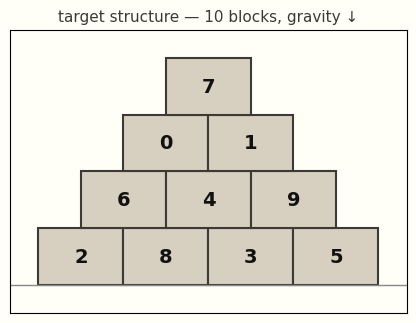
The user-turn text is correspondingly bare — the image does all the geometry:
There are 10 blocks with ids [0, 1, 2, 3, 4, 5, 6, 7, 8, 9]. Your job is to find a placement order that passes the verifier.
Call submit_plan with a permutation of all 10 ids.
With a Vision-Language Model (VLM)
We used kimi-k2p5 via the Fireworks API; the call costs well under $0.01.
playing as the agent, pyramid_10 is unsurprisingly solved in one shot. The VLM does not need to be told anything extra — it can simply see everything.
Comparison
They say no blog should finish without a plot. So here it is showing the five methods we explained so far, working with the same loop, the same environment. The metric is best-so-far block similarity: the fraction of blocks the agent has ever successfully placed before a verifier failure. A score of 1.0 means a fully feasible plan.
pyramid_10. Symbolic agents (random, Z3) climb step-by-step as the verifier teaches them precedence constraints. The no-geometry LLM lands in the same regime as random;
The LLM (with proper geometric description) and VLM (with an image) both solve it in one shot.
Discussion
The symbolic and neural approaches are mirror images of each other. Symbolic synthesis encodes the problem into a formalism cut off from the world and runs a solver that manipulates only symbols. Neural synthesis hands it to a model that already carries rich priors about the world, in whichever modality (text, images). Their strengths and weaknesses are the same fact read from opposite sides.
Symbolic synthesis is powerful because it knows nothing: its algorithm is agnostic to the real world, and that is what lets the same backend solve pyramids, recipes, course scheduling, circuit verification, and Python package dependency resolution alike — efficiently, reliably, and trustworthily. Neural synthesis is powerful because it tries to know a great deal: the priors a foundation model has internalised from terabytes of writing, code, images, and videos are exactly what a SAT solver cannot have, and that is what makes it so good at guessing.
Cost and speed
For this toy task, the mirror shows up in cycles and dollars too. Symbolic agents are local CPU work — a handful of (incremental) Z3 queries, finishing in a fraction of a second on a laptop, with all the cost sitting up-front in a few minutes of human labor spent on the encoding. Neural agents, on the other hand, push a few thousand tokens through a frontier model per round.
Beyond wall time on my laptop, we can give a very rough estimate of the compute.
A successful LLM or VLM run on pyramid_10 costs around \(10^{14}\) FLOPs and roughly one US cent in API fees. The symbolic route is effectively free at runtime and expensive at design time; the neural route is the opposite.
Very rough estimation. The LLM model we use, DeepSeek-V3p1, activates roughly 37B parameters per token; a successful run on the geometric prompt spends a few thousand tokens, giving \(\sim 2 \times 37\mathrm{B} \times 3\mathrm{K} \approx 2 \times 10^{14}\) FLOPs. Kimi-K2p5 is in the same ballpark. I am not good at these estimations, so my formula might be wrong.
Closing words
Neither paradigm has to win. In fact, what can actually make a difference is perhaps something in between. We want methods that carry a reasonable prior about the real world, and we also want methods that can solve complicated problems (thousands, millions of constraints) reliably. The simple pyramid-10 task might give the reader a false impression that the LLM/VLM is a clear win; it is not. LLM/VLM agents would suffer hugely on a much larger, industrial-scale problem.
I think we will want the LLM/VLM to understand the error (stored as plain text, or in any other format), so that we have more freedom in designing the feedback we get from the environment. We should also equip them with the right harness/scaffolding so that the agent knows when to rely on its internal knowledge for a quick decision, and when to invoke a more reliable tool and delegate the heavy-lifting planning to it. In this way we can probably get the best outcome.